
leave a message
If you are interested in our products and want to know more details,please leave a message here,we will reply you as soon as we can.

Specializing in the design of non-standard automated production lines. Proficient in OEE (Overall Equipment Effectiveness) optimization and phased automation implementation, ensuring the high-precision assembly of medical and lighting products without interrupting production.
By Synrit Automation | Industry: Minimally Invasive Surgery · Medical Consumables
For OEMs and contract manufacturers producing trocars for laparoscopic and endoscopic procedures, two numbers matter more than any others: how many units come off the line each hour, and how many of those units are good. Push UPH too hard and defect rates climb; hold yield too tight and you are paying for a machine that idles. This article explains what a realistic average UPH looks like for a fully automatic trocar assembly line and, more importantly, the engineering levers that let you raise speed without sacrificing yield.
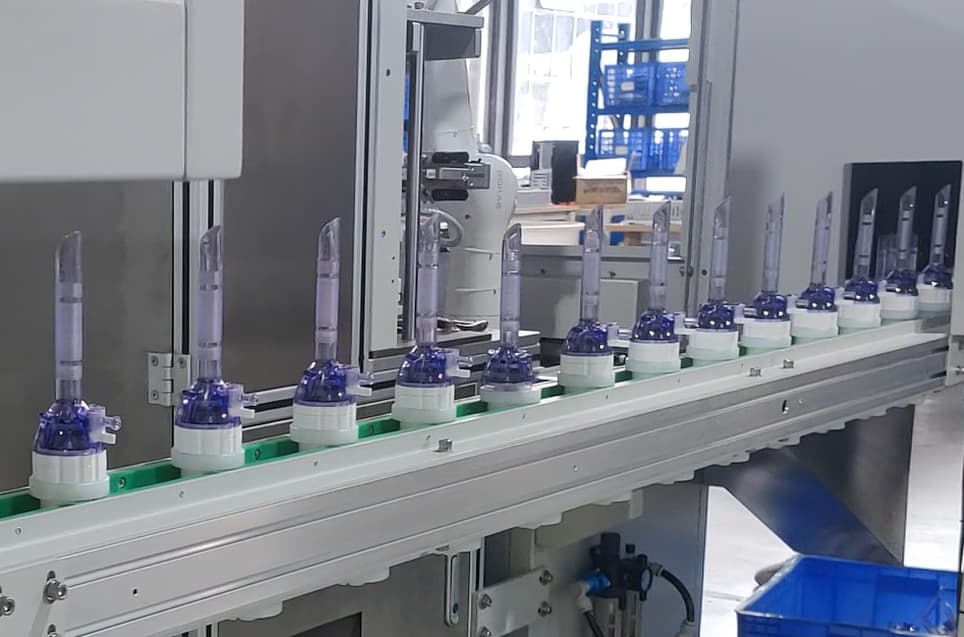
UPH (units per hour) measures throughput across the whole line — from feeding the first component to the finished, tested trocar leaving the station — including changeovers, brief stops and rework loops. It is not the cycle time of the fastest station measured in isolation.
The backbone of any calculation is takt time:
UPH = 3,600 ÷ takt time (seconds)
If a line completes one assembled trocar every 6 seconds at a sustained rate, nominal UPH is about 600. In practice, sustained output is lower than the theoretical figure once you subtract small stoppages, feeder jams and scheduled verification. Always distinguish three numbers: theoretical cycle UPH, demonstrated/qualified UPH, and sustained shift UPH. Procurement decisions should be made on the last one.
There is no single industry-standard answer, because output scales with design choices. As a planning reference, a fully automatic trocar assembly line is commonly designed to run in the range of roughly 400–600 UPH for a typical multi-component trocar (housing, valve/seal, cannula tube, obturator and so on), depending on:
Exact figures for a specific product must be confirmed against actual line specs and demonstration runs. Treat the range above as a planning reference, not a guarantee.
On a trocar line, faster does not automatically mean better — for reasons that are mechanical before they are statistical:
This is the real trade-off: a line tuned purely for speed produces more units but a lower good-unit rate, so net good UPH (yield × UPH) can actually fall.

The goal is to increase net good UPH, not raw cycle speed. The levers, in the order most automation teams apply them:
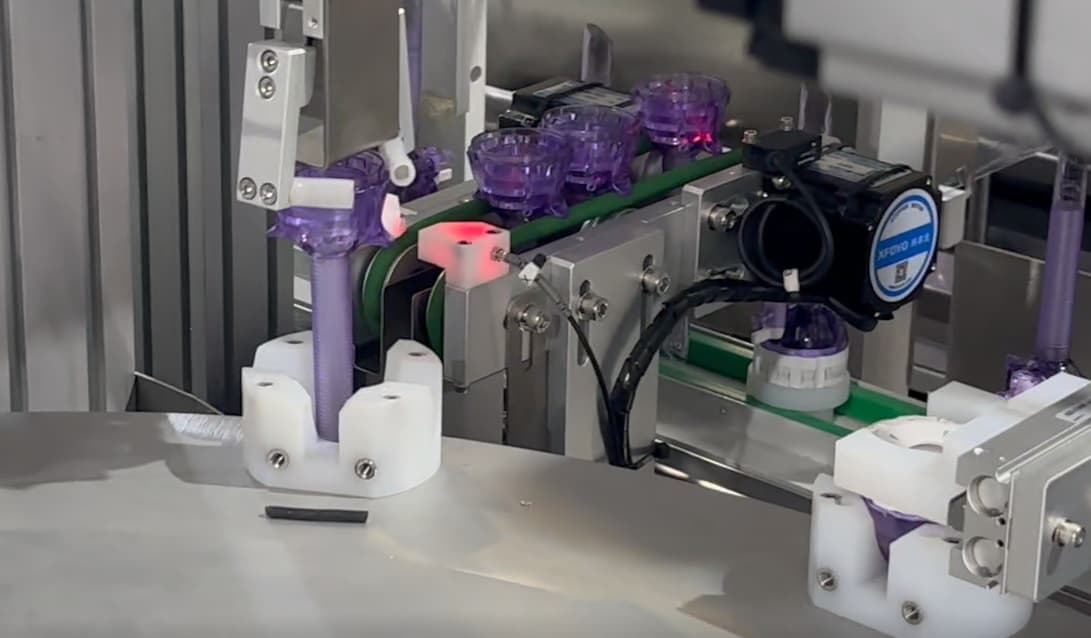
Trocar manufacturing is not generic light assembly. The line must also handle:
These requirements push you toward a line that is fast and instrumented — not one that trades away verification to chase a headline UPH number.
A realistic planning figure for a fully automatic trocar assembly line is on the order of 400–600 UPH depending on product complexity and station design — and the figure you commit to should always be the demonstrated, sustained number. The smart way to grow output is to raise net good UPH: find the bottleneck, protect fragile components with gentle handling, verify in-process, and parallelize rather than merely accelerating. In a clinical consumable, the units that count are the good ones.
If you are sizing a new line or rebalancing an existing one, talk to an automation engineer with trocar-specific experience before locking a target — the right decision at the planning stage saves the most money later.
Q1: What is a typical UPH for a fully automatic trocar assembly line?
A: As a planning reference, roughly 400–600 UPH for a typical multi-component trocar, depending on part count, station design and quality spec. Confirm the exact figure against your actual line demonstration and trial production.
Q2: What is the difference between theoretical and sustained UPH?
A: Theoretical UPH assumes no stops; sustained UPH subtracts small stoppages, feeder jams and verification. Always size capacity on the sustained number.
Q3: Does increasing line speed reduce yield?
A: It can, if you simply cut dwell time or raise acceleration. Protecting yield at higher speed requires gentle handling, in-process verification and parallel stations rather than faster single stations.
Q4: How do you improve yield without slowing the line?
A: Find and fix the bottleneck, add buffers, move inspection in-process, and run SPC so drift is caught before it becomes a defect event.
Q5: Can the same line handle different trocar models?
A: Usually yes, with tooling changeover. Modular stations and quick-change tooling let you rebalance the line for different models; plan changeover time into your UPH math.



 IPv6 Network Supported
leave a message
Scan to Wechat/Whatsapp :