leave a message
If you are interested in our products and want to know more details,please leave a message here,we will reply you as soon as we can.
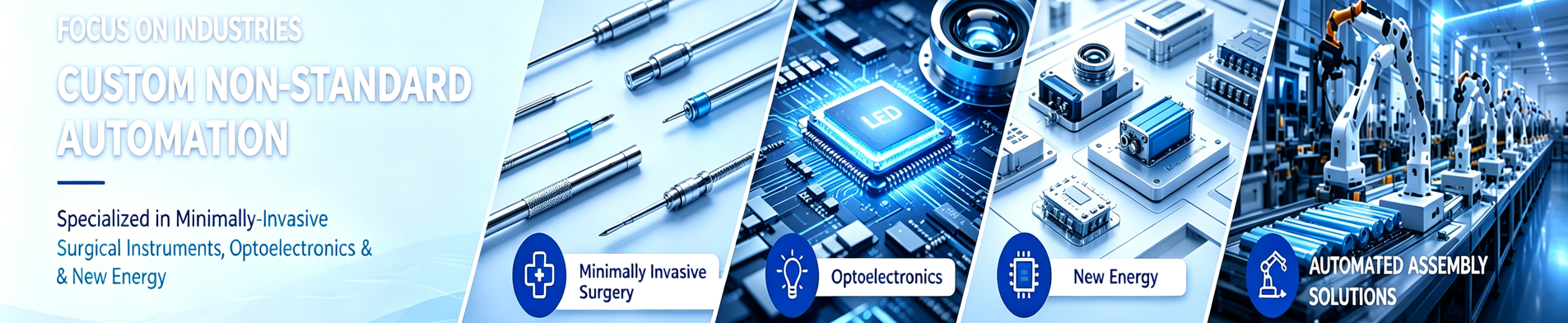

Specializing in the design of non-standard automated production lines. Proficient in OEE (Overall Equipment Effectiveness) optimization and phased automation implementation, ensuring the high-precision assembly of medical and lighting products without interrupting production.
Many medical automation projects fail due to excessive hardware investment. True competitiveness lies in deep knowledge of medical manufacturing processes. Synrit delivers process-first automated production solutions for medical device manufacturers.
As intelligent manufacturing for medical devices develops rapidly, most automation upgrades fall into the same trap. Many believe high-end equipment, precision hardware and fully automatic production lines equal complete medical intelligence.
Companies spend heavily on robotic arms, sensors and smart machinery, only to end up with low line utilization, limited yield improvement, cumbersome workflows and hidden compliance risks.
A clear consensus has emerged across the industry: Medical automation does not compete on hardware specs. It hinges on deep understanding of medical production workflows, compliance standards and manufacturing logic.
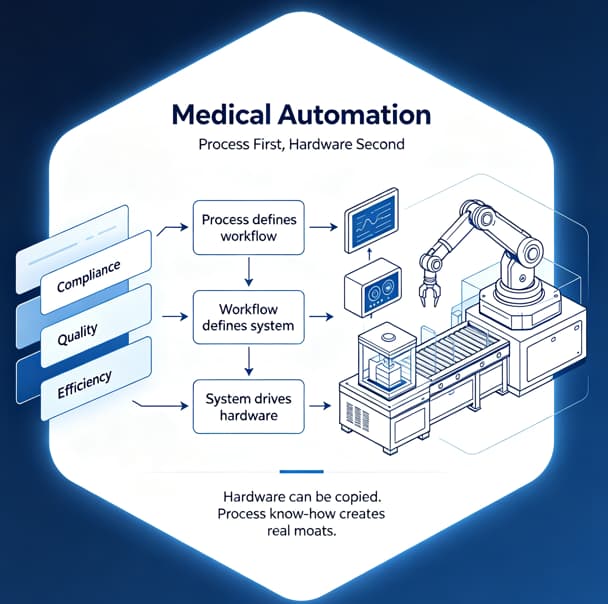
Hardware can be purchased, replaced and copied anytime. In contrast, accumulated process know-how, hands-on workflow experience and reliable compliance delivery form your long-term competitive moat.
General industrial automation boosts productivity mainly by upgrading equipment precision, for mass-produced standard goods with fewer regulatory constraints.
Medical manufacturing operates under entirely different rules. The production of medical devices, consumables and IVD products requires strict control over clean environments, sterilization, operational precision, micro-volume processing and full traceability. Every working step and parameter adjustment directly impacts product quality and patient safety.
Most off-the-shelf automation hardware is designed for general industrial use and cannot meet unique medical process requirements. Simply deploying premium equipment without process adaptation results in sophisticated machinery paired with messy workflows and compliance gaps. These projects become demo systems with little practical production value.
The golden principle for reliable medical automation remains unchanged: Process defines workflow, workflow defines system, system drives hardware.
Automation equipment is merely a tool to execute defined processes, never a replacement for process design.
Professional automation projects do not start with equipment procurement. Our team first dissects the entire production chain, identifies non-standard operations, redundant steps, quality control blind spots and compliance loopholes. We standardize processes, normalize workflows and close quality management gaps at the initial stage.
Once process optimization finishes, we select suitable automation hardware, control systems and intelligent modules according to actual production demands.
This inside-out transformation truly resolves manufacturing bottlenecks, raises yield, stabilizes quality and meets compliance requirements.
Compliance is the bottom line for the medical sector. Hardware upgrades alone cannot satisfy requirements for cleanroom production, audit trails and closed-loop quality control. With in-depth medical process knowledge, we embed compliance logic into every production step, helping automated lines align with industry standards and avoid costly rework or regulatory risks.
Many automation projects fail not because of poor equipment, but poor scene awareness. Process-oriented automation targets practical challenges including sterile manufacturing, micro-volume dosing, precision assembly, flexible production and consistent quality. We cut flashy, useless features and only implement practical upgrades that boost productivity and product quality.
Blindly purchasing premium hardware increases spending on procurement, maintenance and debugging. Process-centered upgrades prioritize workflow optimization, minimize human error and lift product yield before allocating equipment resources. This approach prevents over-investment and idle machinery, delivering higher long-term ROI and operational stability.
The hardware dividend in medical automation has faded. High-end equipment, intelligent modules and mechanical structures are all commercially available; no player can maintain exclusive advantages by hardware alone.
Future competition will no longer focus on equipment parameters or pricing. Winners compete on process expertise, on-site delivery capability, compliance frameworks and custom-tailored solutions.
Only suppliers with solid medical manufacturing insights, refined process control and scenario-based compliance knowledge can help manufacturers achieve genuine smart manufacturing.
Medical automation is not an arms race of expensive machinery. It represents digital transformation and standardized reconstruction of medical production processes.
Break free from hardware-centric competition. Prioritize process design, let equipment serve workflows and tailor technology to production scenarios. This is how we build stable, compliant, efficient and sustainable automated lines for medical manufacturing.
Q1: Does higher-spec hardware guarantee better medical automation performance?
A: Not necessarily. Hardware is just an execution tool and cannot fix non-standard workflows, poor process design or incomplete compliance frameworks. Proper equipment matching aligned with your manufacturing process outperforms stacked high-end hardware in effectiveness, stability and cost control.
Q2: Why are standard industrial automation solutions unsuitable for medical factories?
A: General industrial automation prioritizes output speed and mass production without strict requirements for cleanrooms, sterilization, micro-precision or full audit traceability. Generic solutions lack medical process expertise and often suffer compliance issues, unstable operation and failed mass production after deployment.
Q3: What specific problems can process-driven automation solve?
A: It addresses three major challenges: full production traceability and compliance, elimination of showcase-style automation to realize real quality and efficiency gains, reduction of redundant hardware investment and long-term maintenance costs.
Q4: What is the biggest challenge in medical automation transformation?
A: The primary difficulty lies in standardizing medical processes while integrating compliance rules. Medical procedures are delicate and heavily regulated, with frequent updates to industry requirements. It demands teams proficient in automation engineering, medical manufacturing and regulatory knowledge — capabilities most general automation vendors do not possess.
Q5: How can medical device factories implement automation upgrades on a limited budget?
A: Optimize processes and workflows before buying equipment. Standardize workflows, streamline working steps and close quality control loops first. Deploy automation hardware gradually as needed. This strategy delivers intelligent transformation with minimal investment and optimal cost performance.



 IPv6 Network Supported
leave a message
Scan to Wechat/Whatsapp :