
leave a message
If you are interested in our products and want to know more details,please leave a message here,we will reply you as soon as we can.


Specializing in the design of non-standard automated production lines. Proficient in OEE (Overall Equipment Effectiveness) optimization and phased automation implementation, ensuring the high-precision assembly of medical and lighting products without interrupting production.
Abstract: As volume-based procurement drives prices down and orders shift toward small-batch, multi-variety production, changeover capability is becoming a key competitive edge for disposable trocar manufacturers. This article breaks down four unique challenges of multi-size trocar changeover, uses the SMED methodology to clarify where changeover time goes, and offers six systematic, actionable directions to help manufacturers quantify and improve changeover efficiency.

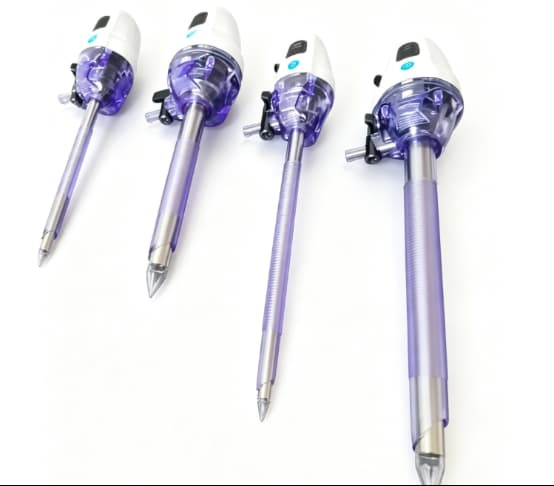
The popularity of laparoscopic surgery has taken the disposable trocar from a single standard product into an era of specification fragmentation. Based on registration certificates and clinical needs, trocars are typically classified by inner diameter — 3mm, 5mm, 10mm, 12mm, 15mm — and further differentiated by cannula length (70mm, 100mm, 150mm, etc.), single-port or multi-channel design, bladed or blade-less, and visible or non-visible types. Managing dozens of SKUs at once has become normal for many manufacturers.
At the same time, volume-based procurement (VBP) is reshaping the order structure of this track. In recent years, multiple provincial medical insurance platforms have included disposable trocars in centralized volume-based procurement, with winning bid prices falling significantly. After price cuts, manufacturers can no longer rely on a single best-selling specification, and order structures are clearly shifting toward small-batch, multi-variety, and more frequent replenishment.
Surgical scenarios are becoming more segmented, orders are getting smaller and more scattered, and line changeovers are becoming more frequent. Changeover capability has become a key variable determining capacity utilization and delivery competitiveness in the small-batch, multi-variety era.
Most managers focus on takt time and unit cost while overlooking the "non-value-added time" of changeover. According to industry observations, some medical device manufacturers spend one to two hours on a single changeover; if a line switches several times a day, effective output time can be cut by as much as a quarter.
With 30–60 changeovers per month, the capacity lost to changeover can reach tens of hours per month. This does not even include trial-run scrap, first-article inspection time, and the quality risk of mixing materials or batches during changeover.
The cost of slow changeover is not just downtime — it is the erosion of delivery capability and profit margins.
As sterile Class II medical devices, disposable trocars bring four distinct challenges to changeover on automated assembly lines:
1) Numerous and delicate tooling/fixture changes. A trocar consists of multiple components — cannula sheath, insufflation valve, seal assembly, and end cap. Automated assembly lines involve many loading fixtures, positioning jigs, press-fitting dies, and inspection fixtures. Moving from 5mm to 12mm does not just change dimensions; the number of tooling often multiplies, and positioning deviations become easy to introduce during the switch.
2) Low degree of process-parameter recipe management. Operations such as press-fitting, seal assembly, air-tightness testing, and torque testing all have specification-specific process parameters. If parameter adjustment relies on experienced technicians "manually finding" the right values, each changeover becomes a lengthy trial-and-error session with inconsistent results across shifts.
3) Quality verification during changeover is non-negotiable. After each changeover, first article inspection must be completed — dimensions, airtightness, sealing performance, puncture force, and sterile packaging integrity, none of which can be skipped. In the medical device industry, changeover is treated as a quality risk point, and any attempt to compress verification is a red line.
4) Traceability and labeling changeovers. Each specification corresponds to a separate batch number, serial number, material traceability, and label system. The risk of mixing materials and batches during changeover requires additional control.
The first step to solving the changeover challenge is not buying new equipment, but breaking down the entire changeover process. Here we draw on the mature lean methodology SMED (Single Minute Exchange of Die), which classifies changeover operations into two types:
On most lines, a large amount of external work that could have been done in advance is instead done during downtime, while internal work is further prolonged by numerous fasteners and repeated adjustments.
The root cause of slow changeover is often process design, not worker speed.
① Modular quick-change tooling — turning "line changeover" into "module changeover." Design shared components as standardized bases and change only specification-specific parts. Replace multi-bolt fastening with quick-release clamps, locating pins, and one-touch clamping to compress internal operation time at the source.
② Recipe-based, one-touch parameter management. Fix the parameters for press-fitting, air-tightness testing, and torque testing of each specification into recipe files and switch with one click during changeover. This eliminates manual trial-and-error adjustment while ensuring parameters are traceable and compliant with verification requirements.
③ SMED internal/external separation and parallelization. Move all external operations upfront, and have two operators work in parallel from both sides of the line, converting serial operations into parallel ones — the highest-ROI step in compressing changeover time.
④ Standardized changeover procedures and visual management. Establish a standard changeover SOP and a changeover checklist that defines each step, its tools, and standard time. Use fixed-position, visually marked tooling and materials so even new operators can complete changeovers quickly to standard.
⑤ Parallelized first-article verification. While changeover work is underway, prepare inspection tooling and inspection documents in parallel. Where conditions allow, set up in-line rapid inspection stations so first-article confirmation does not have to wait until the whole line is back up, reducing "verification waiting."
⑥ Error-proofing and traceability upfront. Use barcode scanning, color coding, and mechanical error-proofing to ensure tooling and materials match the target specification, preventing mix-ups. Automatically switch material and batch identification at the changeover node to control batch-mixing risk at the source.
Using a commonly achievable improvement as an example (illustrative figures): if a single changeover is reduced from 90 minutes to 30 minutes, with 40 changeovers per month on a single line, roughly 40 hours of effective capacity can be released per month — a significant improvement in OEE and output per operator.
More importantly, the knock-on effects:
Under the twin pressure of volume-based procurement and homogeneous competition, whoever optimizes capacity utilization and delivery response in the small-batch, multi-variety rhythm will hold the advantage in both cost and orders. Changeover capability is exactly where this advantage is concentrated.
For manufacturers planning or upgrading trocar assembly lines, we recommend evaluating three benchmarks first: the real data of current changeover time and frequency, the ratio of internal vs. external operations, and the degree of tooling modularity. Once these three benchmarks are clear, changeover optimization has a clear starting point.
Q1: How long should a changeover take? Is there an industry benchmark? Changeover time is directly related to line complexity and the number of specifications, so there is no universal "standard value." However, from the SMED improvement target, mature lines usually keep changeover within 30 minutes, with the ideal approaching 10 minutes (the "single-minute exchange of die" concept). To judge whether your changeover is normal, look at two things: how frequent changeovers are, and what share of effective production time they consume — the higher the share, the more worthwhile the optimization.
Q2: Will shortening changeover time compromise quality verification or create compliance risk? No — provided what you compress is "ineffective waiting," not the verification itself. First article inspection, airtightness, sealing performance, puncture force, and other verification items during changeover are red lines that must not be skipped. The focus of SMED optimization is to move preparatory work — staging materials, retrieving tooling, and checking parameters — before downtime, leaving downtime only for "disassembly/installation plus necessary verification." Verification waiting itself can be reduced through in-line rapid inspection stations and parallelized first-article confirmation, without reducing any inspection items.
Q3: With smaller orders, what batch size justifies a changeover? Is frequent changeover cost-effective? The criterion is not order size but "changeover cost vs. changeover benefit." The economic production quantity (EOQ) decreases as changeover time drops — when changeover is reduced from 90 to 30 minutes, small-batch orders can turn from unprofitable to profitable. We recommend comparing "changeover capacity loss × unit capacity value" against "lead time/order value released after changeover." At the same time, merge orders of the same specification or process family to reduce the number of switches.
Q4: Is changeover optimization expensive? Can a small factory without a lean team do it? You can start with low-cost improvements, and the three highest-ROI actions cost almost nothing: ① record the entire changeover on video and break it down to identify internal vs. external operations; ② move external operations upfront (stage materials, tooling, and parameters in advance); ③ establish a one-page changeover SOP and checklist. These three steps alone usually cut changeover time by 30%–50%. Hardware upgrades such as modular tooling and recipe-based parameter management can be invested in gradually after the benefits are validated.
Q5: What direct benefits do the time savings bring to customers and orders? The most direct benefit is delivery capability: the faster the changeover, the more small and urgent orders the same capacity can take on, and the faster the response to VBP and channel orders. At the same time, production flexibility improves, allowing you to arrange production sequences on demand and reduce finished-goods inventory and working capital. From the customer's perspective, it means shorter lead times and more stable supply.



 IPv6 Network Supported
leave a message
Scan to Wechat/Whatsapp :