Modern manufacturing is undergoing rapid transformation. The traditional production model of single-specification, large-batch manufacturing can no longer adapt to the market’s diverse demands. With accelerating product iteration, customized production requirements and stricter production precision standards, rigid and fixed standard automation equipment gradually shows limitations. For this reason, tailor-made non-standard automation production lines have become the preferred upgrade choice for more and more modern manufacturing factories.
Limitations of Traditional Standard Automation Equipment
Standard automated equipment is designed for universal and generalized production scenarios, focusing on large-scale, fixed-process, and single-product manufacturing. It works well for industries with stable product structures and no frequent upgrades. However, most emerging and precision manufacturing scenarios require flexible processes, personalized assembly, and high-precision detection.
Most standard machines adopt fixed fixtures and solidified process logic, with single functional scenarios and poor compatibility. When factories update product structures, adjust process details or expand product categories, standard equipment often fails to adapt. Enterprises have to spend heavily on equipment renovation or purchase new machines directly, resulting in low equipment utilization, increased production costs, and restricted workshop production flexibility.
Core Advantages of Custom Non-Standard Automation Lines
Different from generalized standard equipment, non-standard automation abandons rigid unified design. All production lines are tailor-made according to customers’ actual workshop conditions, product structural characteristics and personalized process requirements, accurately solving practical production pain points and realizing highly matched automated production.
1. Strong production flexibility and wide compatibility
Custom production lines adopt modular combined structures and adjustable fixture designs, supporting fast switching of multiple product specifications and flexible adjustment of production processes. It perfectly fits the mainstream production mode of small batches, multiple varieties and fast iteration in modern manufacturing. Enterprises do not need to replace equipment frequently due to product upgrades, greatly improving equipment utilization and saving long-term equipment investment costs.
2. Highly matched personalized production processes
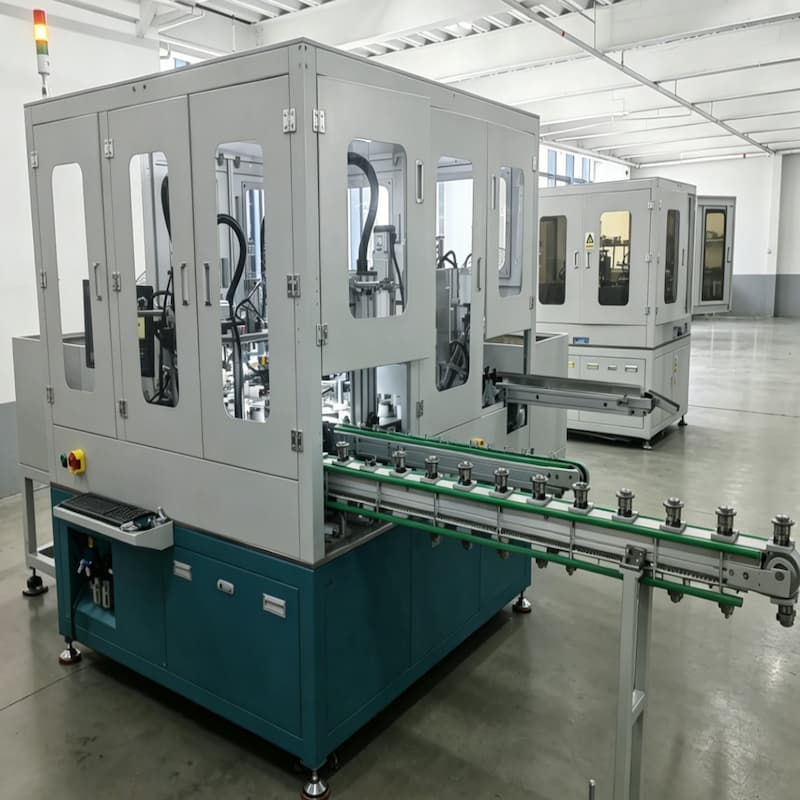
Many precision products have unique assembly, detection and packaging processes, which cannot be fully covered by general standard equipment. Taking
disposable puncture device assembly lines as a typical example, such high-precision medical products consist of casings, sealing rings, valve membranes, gaskets, rear covers and other tiny precision parts. They require ultra-high assembly accuracy, and support integrated processes including precise dispensing, real-time online visual inspection, and automatic defective product rejection. General standard equipment fails to meet such stringent and specialized production standards. Custom non-standard automation can formulate exclusive process flows, high-precision positioning schemes and targeted detection systems based on product characteristics, effectively solving common production problems such as assembly deviation, part damage and unstable yield, and fully guaranteeing consistent product quality.
3. Lower long-term comprehensive production costs
Customized equipment is designed based on actual production demands, without redundant functional settings or resource waste. It optimizes manual auxiliary links and realizes integrated automation of assembly, detection and packaging, effectively reducing labor costs and product defective rates. At the same time, the modular structure greatly reduces the difficulty and cost of later equipment transformation, maintenance and iteration, bringing higher and more stable long-term return on investment for factories.
Which Factories Are Suitable for Non-Standard Automation Customization?
Non-standard automation customization is applicable to most manufacturing scenarios with diverse product specifications, frequent iterations and high precision requirements. It is especially suitable for enterprises that pursue flexible workshop production, stable product quality and controllable comprehensive costs, and has become an important way for modern factories to realize intelligent transformation and efficiency improvement.
Final Thoughts
There is no absolute distinction between good and bad for standard automation and custom automation—only differences in application scenarios. Standard equipment is suitable for fixed and large-batch single-product production, while customized non-standard automation focuses on solving flexible, personalized and multi-scenario production pain points. With the continuous refinement and upgrading of the manufacturing industry, tailor-made non-standard automation solutions will become the mainstream trend of factory intelligent upgrading.
Synrit Positioning Moving forward, Synrit will focus on providing professional non-standard automation customization solutions for the medical and optoelectronic industries. With rich experience in precision production line R&D and manufacturing for core products such as medical puncture devices and optoelectronic precision components, we provide one-stop customized services including automated assembly, high-precision detection and integrated packaging, helping precision manufacturing enterprises achieve flexible production, quality stabilization and cost reduction.
FAQ
Q1: What kinds of products need custom non-standard automation lines?
A: Products with diverse specifications, tiny precision parts, special assembly processes, and frequent iteration are the most suitable. Typical cases include medical puncture devices, disposable medical consumables, and miniaturized optoelectronic components. Standard equipment cannot meet their high-precision and personalized production requirements.
Q2: Is the cost of custom automation lines much higher than standard machines?
A: The one-time investment of customized equipment is targeted, without redundant functional costs. In mass and long-term production, customized lines effectively reduce defective rates, equipment replacement frequency and manual costs. The comprehensive long-term cost is far lower than repeatedly modified standard equipment.
Q3: How long is the customization cycle for a precision assembly line (such as a puncture device line)?
A: It depends on product process complexity. For mature precision assembly projects like medical puncture devices, Synrit can complete scheme design, mechanical debugging and trial production verification in a reasonable cycle, ensuring fast delivery and stable equipment performance.
Q4: Can custom automated lines support product iteration and model upgrading?
A: Yes. All our customized lines adopt modular flexible design. When customers upgrade product structures or adjust process parameters, the equipment can be quickly adapted through partial adjustment, avoiding overall scrapping and greatly improving equipment reuse rate.




 IPv6 Network Supported