The assembly of A/T-type LED bulbs generally faces five major pain points: component alignment deviation, production efficiency bottlenecks, unstable glue sealing quality, high labor costs, and imperfect quality control processes. Most of these problems stem from manual operations, which easily lead to high defect rates, limited production capacity and rising costs.
As a professional solution provider,
synrit delivers automated solutions integrating precision vision positioning, multi-station integrated production lines, quantitative dispensing and real-time detection modules, minimizing manual intervention at the source.
The equipment improves assembly accuracy by over 90%, boosts hourly output by 5–8 times, and reduces defect rates by 70%. It helps LED bulb manufacturers stabilize product quality while expanding production, serving as a core solution for the industry to cut costs and enhance efficiency.
1. Manual Component Alignment Deviation
Problem Analysis
Key parts of A-type LED bulbs, including lamp bases, LED light boards, driver boards and bulb shells, are manually positioned during assembly, frequently causing offset, tilting and misalignment.
For instance, center deviation between the light board and lamp base results in uneven light emission; misalignment between the bulb shell and lamp base weakens sealing performance.
Production lines relying on manual work often see defect rates exceeding 15%. Meanwhile, worker fatigue reduces operational consistency and causes quality fluctuations between batches.
Automated Solution
Custom positioning fixtures paired with a vision positioning system developed by synrit completely eliminate manual alignment errors.
Servo-driven modules realize micron-level alignment and zero-point precise clamping for all components to ensure consistent and unified assembly accuracy, and guarantee the assembly uniformity of light boards, bulb shells and lamp bases.
2. Low Assembly Efficiency & Capacity Constraints
Problem Analysis
Manual operations such as dispensing and pressing are obviously restricted by physical strength and working speed.
During peak order periods, production lines often fail to meet shipment demands, resulting in delayed delivery and customer loss.
Even skilled workers can hardly output more than 300 units per hour, forming a core bottleneck for large-scale production.
Automated Solution
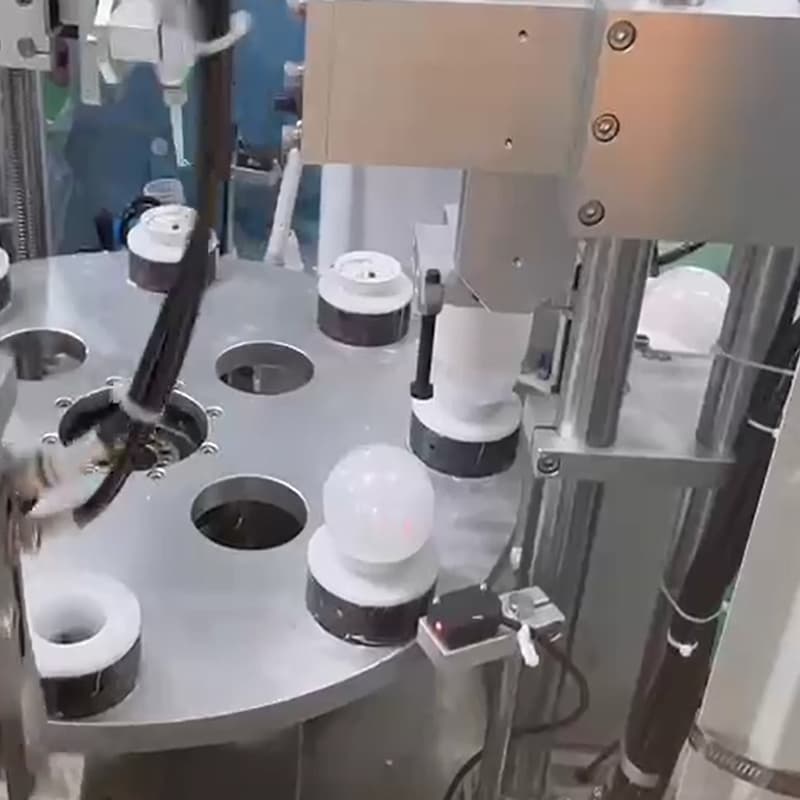
synrit’s multi-station rotary integrated assembly line enables synchronous operations of feeding, assembly, glue sealing, testing and aging.
The hourly output reaches 2,400 units, 5–8 times higher than manual work.
the equipment flexibly adapts to diverse capacity demands without additional labor costs for production expansion.
3. Unstable Glue Sealing Quality
Problem Analysis
Manual glue application for sealing between lamp bases and bulb shells commonly causes uneven glue dosage, missing glue and glue overflow.
Poor sealing leads to air leakage and moisture ingress of bulbs, greatly shortening service life.
Since glue quality highly depends on workers’ operating skills, quality varies greatly among batches and results in a high after-sales return rate.
Automated Solution
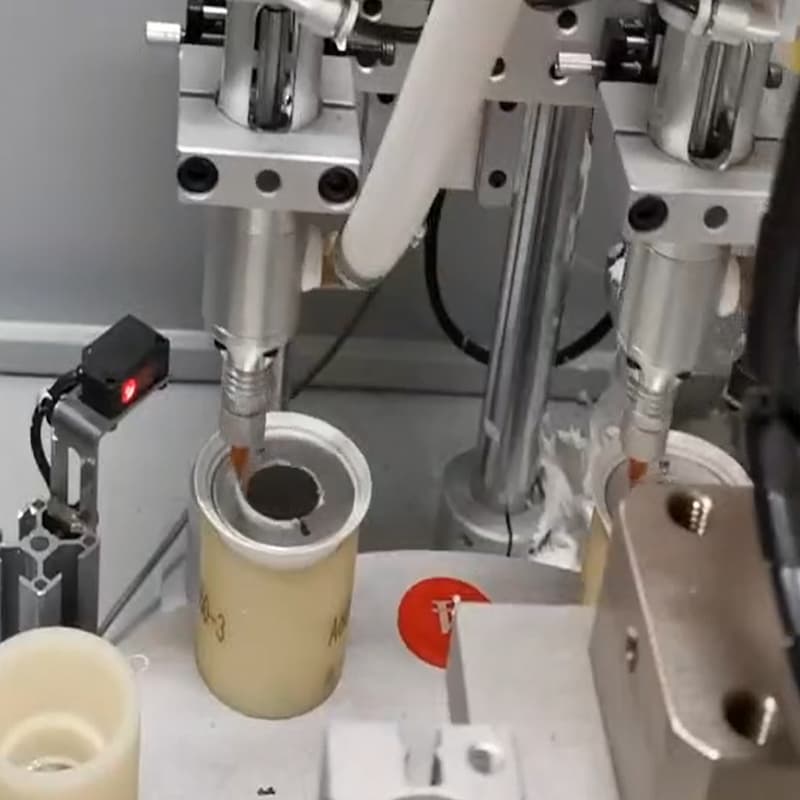
synrit’s high-precision automatic dispensing equipment is equipped with quantitative glue pumps and trajectory planning systems.
The dispensing accuracy is controlled within ±0.01ml, and the glue path fully covers the sealing area between lamp bases and bulb shells, thoroughly resolving cross-batch quality differences.
4. High Labor Costs & High Staff Turnover
Problem Analysis
LED bulb assembly is repetitive and high-intensity work. The monotonous posts lead to high employee turnover and increased training costs for new staff.
Coupled with rising salaries and social security expenses year by year, labor costs account for 30%–40% of the total production costs for small and medium-sized manufacturers.
In addition, non-standard manual operations bring potential risks in quality and site management.
Automated Solution
One set of synrit automated equipment can replace 3 to 6 assembly workers, cutting long-term labor expenses by 60%–70%.
Capable of stable 24-hour operation with low maintenance costs, the equipment reduces reliance on labor and staff mobility to achieve lean production.
Meanwhile, standardized production processes lower the costs of staff training and daily management.
5. Lack of Online Testing & Difficult Quality Control
Problem Analysis
Finished product inspection relies on manual visual checks and simple lighting tests, which easily miss hidden defects such as poor contact, sealing flaws and abnormal luminescence (flicker, color temperature deviation, etc.).
Inconsistent manual quality control standards push the after-sales return rate up to 8%–10%, damaging brand reputation and customer trust.
Automated Solution
synrit’s integrated online detection module synchronously completes power-on lighting tests, air tightness inspection, optical parameter detection (color temperature, brightness, flicker) and visual appearance inspection.
Defective products are automatically identified and sorted in real time to ensure all products meet industry standards.
The after-sales return rate is reduced to below 1%, effectively protecting brand image and market credibility.
FAQ
-
Q: How much can automation reduce the defect rate of A-type LED bulb assembly?
A: synrit
automated led bulb production lines reduce defect rates by 70%–80%, mainly by eliminating manual errors in alignment, dispensing and testing processes.
-
Q: Can automated production lines adapt to different models of A-type LED bulbs?
A: Yes. Adopting a modular design, synrit’s equipment supports model switching for bulbs with different power, color temperature and lamp base specifications within 30 minutes, meeting multi-specification production needs efficiently.
-
Q: What is the ROI cycle of investing in an automated assembly line?
A: Most customers can recover their investment within 6–18 months, benefited from labor cost savings and reduced material waste.
-
Q: Can synrit provide customized solutions for specific production capacity requirements?
A: Absolutely. synrit provides scalable configurations ranging from small-batch to high-volume production, with customized solutions fully tailored to your on-site production demands.






 IPv6 Network Supported