As the lighting industry continues to upgrade, full-process automated production has become the standard for large-scale, stable, and high-quality panel light manufacturing. By adopting standardized and refined automated procedures, Synrit completely eliminates manual process deviations, achieving comprehensive upgrades in production capacity, product consistency, and manufacturing cost control.
1. Full-process Automation Eliminates Traditional Manual Production Defects
Conventional panel light manufacturing heavily relies on manual operations, including glue dispensing, light source installation, soldering, screw fastening, and final assembly. This labor-intensive model suffers from long production cycles and inconsistent manual operation quality. Common manufacturing defects such as uneven glue application, offset light sources, loose screws, and bonding bubbles often lead to finished-product issues including light leakage, dark lighting areas, and glue detachment.
Synrit’s advanced automatic assembly system for downlight panel lights delivers a fully closed-loop unmanned production workflow, covering base plate feeding, automatic glue dispensing, light source assembly, automatic soldering, pressure bonding, frame assembly, diffuser plate dust removal and feeding, screw locking, and finished product unloading. Requiring only a small team for auxiliary loading and unloading, the production line reaches a stable rated capacity of 400 to 600 pieces per hour, significantly reducing labor costs and greatly improving mass order delivery capability.
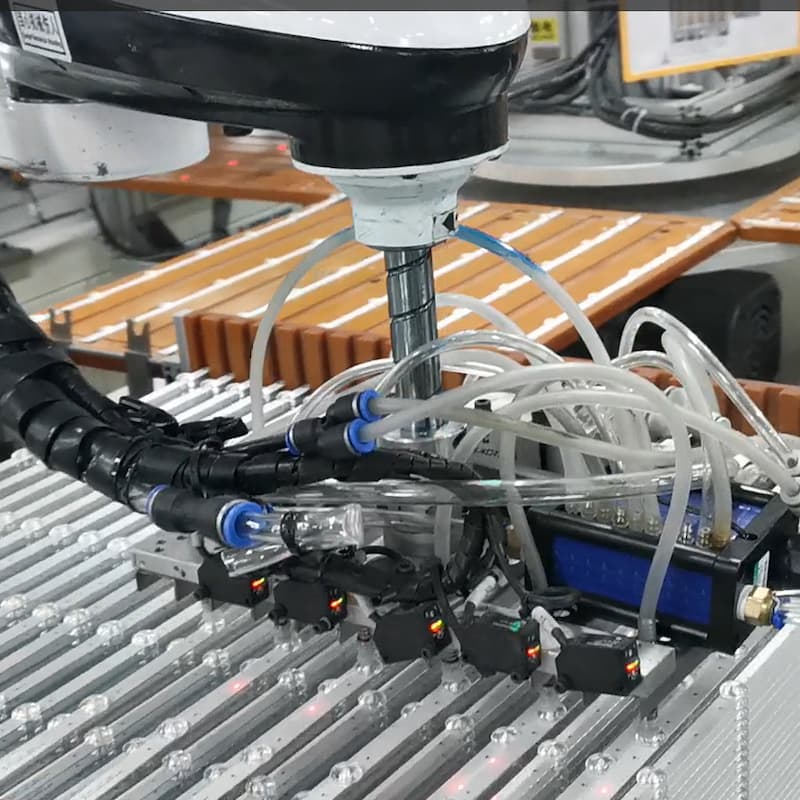
Equipped with dual-alternating lifting feeders, high-precision robotic handling systems, and servo positioning modules, the production line operates with minimal manual intervention throughout the entire process. It effectively eliminates random errors caused by manual work and ensures highly consistent manufacturing standards for every finished panel light.
2. Strict Core Process Control Guarantees Superior Product Performance
The lighting uniformity, optical performance, and service life of downlight panel lights depend heavily on four critical manufacturing processes: glue dispensing, light source bonding, structural fastening, and dust prevention. Synrit’s automated refined process control provides reliable quality assurance for every production batch.
Intelligent Constant-Temperature Glue Dispensing for Stable Bonding
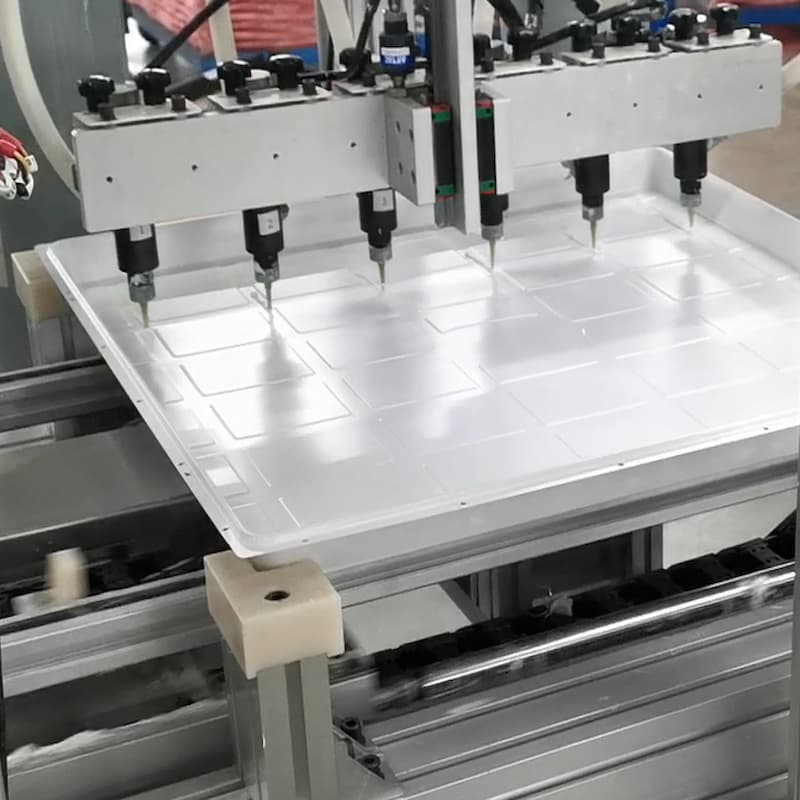
The production line adopts a multi-valve hot-melt glue supply system with dual automatic switching units, supporting continuous glue replacement without production shutdown. With precise pressure and constant temperature adjustment, the system achieves uniform and continuous glue output. It effectively avoids glue breakage, wire drawing, and glue accumulation, ensuring tight bonding between light sources and structural components and permanently preventing glue detachment and light leakage failures.
High-Precision Light Source Assembly for Uniform Light Output
Equipped with automatic robotic pick-and-place systems and servo flexible pressure bonding technology, the line achieves ultra-precise positioning and seamless fitting of light strips. It ensures zero deviation, zero bubbles, and full adhesion between light sources and base plates. Six synchronous automatic welding guns deliver uniform and firm solder joints, effectively eliminating common problems such as LED dead lights, light strobing, and poor contact, thus maintaining stable and uniform lighting performance.
Integrated Dust Removal System for Flawless Optical Quality
Diffuser plates are highly susceptible to dust adhesion, which causes uneven light transmission and visible light spots. To solve this industry pain point, Synrit integrates an ion air gun and vacuum dust removal system. Each diffuser plate undergoes thorough deep cleaning before assembly, completely removing surface dust and impurities to ensure pure, uniform light transmission and enhance the overall optical texture of finished lamps.
Multi-Axis Servo Fastening for Durable Structural Stability
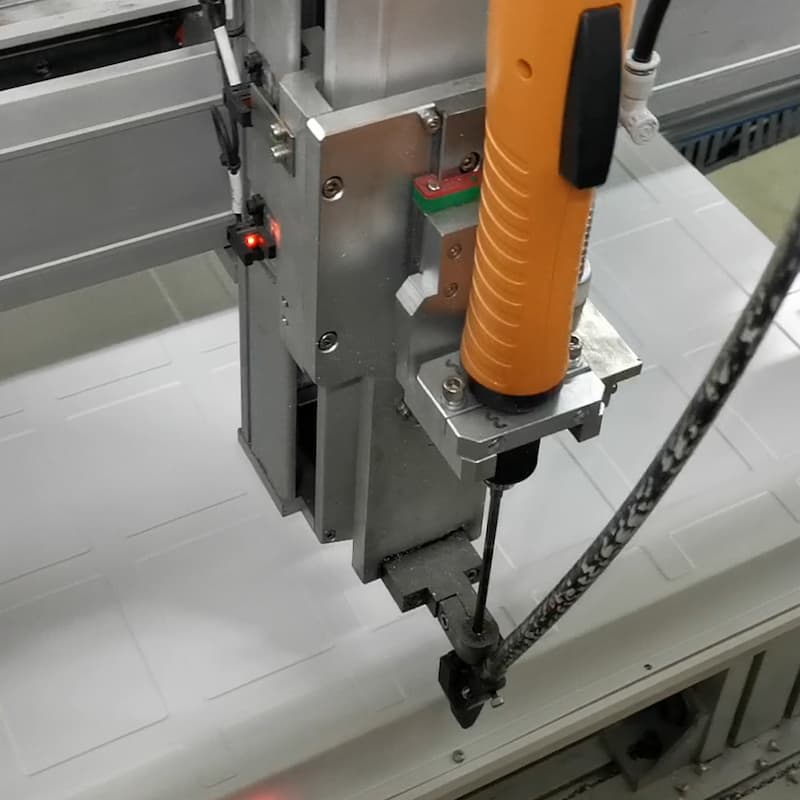
The production line adopts X/Y dual-axis servo modules and automatic screw feeders to precisely control screw fastening positions and torque values. Every screw is fastened evenly and firmly without thread slipping or loose installation. The tight fit between aluminum frames and base plates ensures robust overall structural stability, enabling the panel lights to maintain stable performance during long-term service.
3. Flexible Production Adapts to Diversified Market Demands
To meet the coexisting standardized and customized demands of the modern lighting market, Synrit’s automated assembly system features powerful flexible production capabilities. It stably supports the mass production of mainstream downlight panel lights with sizes ranging from 595*595mm to 620*620mm. Product model switching only requires simple parameter adjustments without complicated mechanical modifications, perfectly adapting to large-batch standardized production and small-batch customized manufacturing scenarios.
Furthermore, the production line reserves dedicated laser mounting positions and standard communication interfaces, supporting functional upgrades and intelligent iteration in the future. The expandable design avoids equipment elimination caused by process upgrades, effectively reducing long-term equipment renovation and replacement costs for lighting manufacturers.
4. Smart Refined Manufacturing Drives Lighting Industry Upgrading
The transformation from extensive manual production to intelligent automated refined manufacturing marks a crucial upgrade for the global lighting industry. Through standardized workflows, intelligent equipment management, and precise process standards, Synrit’s production solution greatly improves product yield and production stability. It helps lighting enterprises achieve core goals of cost reduction, efficiency improvement, and quality enhancement.
As global lighting quality standards continue to improve, automated, flexible, and intelligent manufacturing solutions will become the core competitiveness for lighting brands to break capacity bottlenecks and stabilize market advantages.
Exquisite Craftsmanship for Premium Lighting | Synrit Focuses on Full-process Automated Manufacturing Solutions for Panel Lights
FAQ:
Q1: What is the production capacity of this automatic downlight panel light production line? How much efficiency improvement does it bring compared with manual production?
A1: The line achieves a stable production capacity of 400–600 pieces per hour with full closed-loop automation. Only a small workforce is required for auxiliary loading and unloading. It eliminates time-consuming manual processes, reduces labor costs by more than 60%, and increases batch delivery efficiency by 2–3 times, fully meeting high-volume order production requirements.
Q2: Can this production line solve common quality issues such as light leakage, dark areas, and glue detachment?
A2: Yes. All common panel light defects are fundamentally avoided through four refined core processes. Intelligent constant-temperature glue dispensing prevents glue failure and light leakage; robotic precision bonding eliminates dark areas and uneven brightness; synchronous automatic welding ensures stable circuit connection to avoid dead lights and strobing; and professional dust removal removes light spot defects, greatly improving the finished product yield.
Q3: Can the line support multiple panel light sizes? Is product model switching complicated?
A3: The production line features high manufacturing flexibility and is compatible with all mainstream downlight panel lights sized from 595*595mm to 620*620mm. Product switching only requires simple parameter calibration without equipment disassembly or major modification, supporting both mass production and customized small-batch orders with high efficiency.
Q4: What is the automation level of the equipment? How many workers are required, and is the operation difficult?
A4: The entire production line realizes full-process unmanned automatic operation based on servo positioning and intelligent control systems. Daily operation only requires 4–6 workers for material loading and unloading. The equipment is equipped with an intuitive human-machine interface, easy parameter debugging, and simple maintenance. Ordinary operators can master the operation after basic training, with no need for professional technical staff on duty.
Q5: Is the equipment expandable and support future function upgrades?
A5: Yes. Reserved laser installation positions and standard communication interfaces provide sufficient upgrade space for both hardware and software. New production functions can be expanded according to future process upgrades without replacing the entire production line. This design effectively avoids equipment obsolescence, reduces long-term renovation costs, and improves overall equipment service life and cost performance.



 IPv6 Network Supported