Xiamen Synrit Intelligent offers a comprehensive guide to the intricate customization procedures for non-standard automation equipment. Delving into the depths of demand communication, solution design intricacies, meticulous processing and assembly, through to the meticulous commissioning and timely delivery, our detailed exposition sheds light on the entirety of the bespoke process.Moreover, our expertise extends to elucidating the conventional production cycles distinctive to various types of equipment, facilitating enterprises in the rational strategizing of production launch schedules. With an unwavering commitment to excellence, we navigate the intricate labyrinth of automation equipment customization, providing a seamless and sophisticated service designed to elevate your operations to new heights.
With the rapid development of the intelligent manufacturing industry, more and more manufacturing enterprises are phasing out traditional manual production modes and customizing automation equipment according to their own production requirements. Due to differences in product craftsmanship, production environments and processing standards among factories, standard automation equipment is hardly universal and requires personalized non-standard customization.
Most purchasing enterprises focus on two core questions when consulting manufacturers:
What are the customization steps for non-standard equipment? What is the overall delivery cycle?
This article clearly sorts out the full customization process and industry conventional lead time of non-standard automation equipment, enabling buyers to make advance production plans.
1. Complete Customization Process of Non-Standard Automation Equipment
Reliable non-standard automation manufacturers adopt standardized customized service systems, forming a closed-loop service covering pre-business communication, mid-term production & processing, and post-installation after-sales support. This ensures stable equipment operation and perfect compatibility with factory conditions. The whole process includes six key stages:
1.1 Demand Communication & On-site Survey
The first step is precise demand docking. Our application engineers communicate with clients in detail about production requirements, including product specifications, production capacity, process flow, automation level, budget range and installation site conditions.
For large production lines, technical engineers conduct on-site surveys at the client’s factory, measure site dimensions, confirm power supply, air supply and environmental working conditions, and eliminate installation compatibility risks in advance. We also record production pain points such as high labor costs, low yield rate and slow production speed to support subsequent solution design.
1.2 Solution Design & Quotation Confirmation
- The technical team delivers customized solutions based on survey data and client requirements, including equipment layout drawings, process flow, core configuration, functional description and production capacity parameters.
- After solution finalization, a detailed quotation is calculated based on material selection, processing cost and labor cost.
- Both parties negotiate and revise details of the solution, configuration and price. Once confirmed, a formal customization contract is signed to specify delivery cycle, after-sales terms and payment terms.
1.3 Mechanical Structure Design & Electrical Programming
After contract signing, R&D engineers carry out detailed design work, including mechanical 3D modeling, component selection, frame design and transmission structure design.Electrical engineers simultaneously complete PLC programming, HMI touch screen design and circuit wiring planning.For complex non-standard equipment, simulation testing is conducted in advance to avoid structural interference and program lag, ensuring smooth equipment operation.
1.4 Component Procurement & Equipment Assembly
After drawing review and approval, the procurement department purchases standard components such as motors, cylinders, sensors, servo modules and industrial control parts.The factory machining workshop processes customized parts including frames, jigs and fixtures.After all parts pass quality inspection and warehousing, assembly technicians complete mechanical assembly, circuit connection and pneumatic layout strictly according to assembly drawings to finish overall equipment assembly. The whole assembly follows industrial standards to control precision and reduce subsequent failure rates.
1.5 Equipment Commissioning, Quality Inspection & Trial Operation
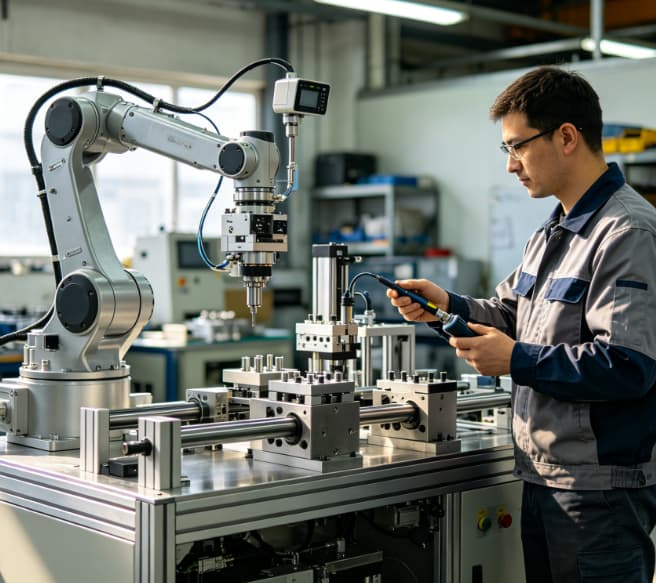
After assembly, technicians conduct comprehensive commissioning, including mechanical action debugging, program logic optimization, precision calibration and safety protection testing.
During commissioning, we simulate actual production conditions to repeatedly test production capacity, yield rate and operational stability, optimizing stalling, abnormal noise and positioning deviation issues.
The quality inspection department performs factory testing in accordance with industry standards. After passing inspection, test run videos will be sent to the client for confirmation.
1.6 Shipment, Installation Training & After-sales Service
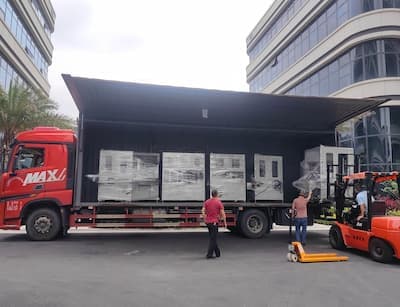
After client confirmation, the equipment is professionally packaged and arranged for logistics delivery.Upon arrival at the client’s factory, our engineers provide on-site installation, wiring debugging and production line docking. Free operation training is offered for operators, covering equipment operation, parameter adjustment, daily maintenance and basic troubleshooting.After delivery, we provide long-term after-sales support including warranty maintenance, technical consultation and equipment upgrade & modification services.
2. Conventional Production Cycle of Non-Standard Automation Equipment
The lead time depends on equipment complexity, electronic component procurement cycle and manufacturer’s production schedule. The industry standard delivery time is classified as follows for enterprise reference:
-
Simple Automation Equipment: 7–15 working daysSmall standalone equipment such as testing machines, pressing machines and simple conveyor lines. Featuring simple structure and high proportion of standard parts, they are easy to design and process, suitable for automated upgrading of single simple working procedures.Examples: marking machines, automatic screw locking machines.
-
Medium Automation Equipment: 15–30 working daysSingle/multi-station assembly machines, semi-automatic production lines and dedicated testing equipment. With moderately complex structure and customized jigs required, they are the most widely used customized equipment in manufacturing.Examples:
plug-in machines, PCB depaneling machines from Xiamen Synrit Intelligent.
-
-
Special Customized Equipment: Over 60 working daysHigh-precision visual inspection equipment, cleanroom-specific equipment and explosion-proof equipment for special working conditions. Custom special components and repeated experimental testing lead to longer R&D and production cycles.
3. Tips to Shorten Customization Lead Time
- Prepare product samples, production requirements and site drawings in advance to avoid repeated communication and revision.
- Prioritize off-the-shelf standard components to reduce procurement time for custom parts.
- Avoid modifying equipment structure and functions after solution confirmation to prevent rework and delivery delay.
- Reserve installation space and complete on-site power & air supply configuration in advance for fast commissioning and production launch.
4. Conclusion
Customization of non-standard automation equipment is a highly professional systematic project. Every link from demand communication, solution design, processing & assembly to commissioning & delivery determines equipment quality and application effect.
Enterprises should focus not only on price, but also on the manufacturer’s standardized process, processing technology and after-sales capability. Understanding the customization process and lead time in advance helps avoid delivery delays and production downtime.
With the continuous upgrading of intelligent manufacturing, the non-standard automation industry will become more standardized and intelligent, helping all manufacturing industries reduce costs, improve efficiency and realize transformation and upgrading.
5. FAQ
Q1: What documents are required for customizing non-standard automation equipment?
A: You only need to provide product samples, dimension drawings, existing process flow, target production capacity, workshop layout size and on-site power & air supply conditions. Our engineers can provide free on-site survey and preliminary solution layout design.
Q2: Can I modify the solution and functions during customization?
A: Free adjustment is available before solution confirmation and contract signing. Modifications are not recommended after drawing finalization and part procurement, which will cause component scrapping, rework, longer lead time and higher cost.
Q3: What is the warranty policy? How to handle equipment failures after delivery?
A: Standard equipment comes with 1-year overall warranty, and core electrical components follow the original manufacturer’s warranty policy. We support remote video guidance and on-site engineer maintenance, as well as lifelong technical upgrade, program optimization and equipment modification services.
Q4: Can I customize automation equipment without detailed technical drawings?
A: Yes. Simply provide product samples and manual production process. Our technical team can conduct on-site process analysis and reverse design the full automation solution, no professional engineering drawings required from your side.
Q5: What is the payment term? Is installment payment available?
A: The industry standard is deposit payment → drawing confirmation → balance payment before shipment, with all terms specified in formal contracts. Reasonable installment terms can be negotiated for long-term cooperative enterprises, with transparent payment process and no hidden charges.





 IPv6 Network Supported