
leave a message
If you are interested in our products and want to know more details,please leave a message here,we will reply you as soon as we can.
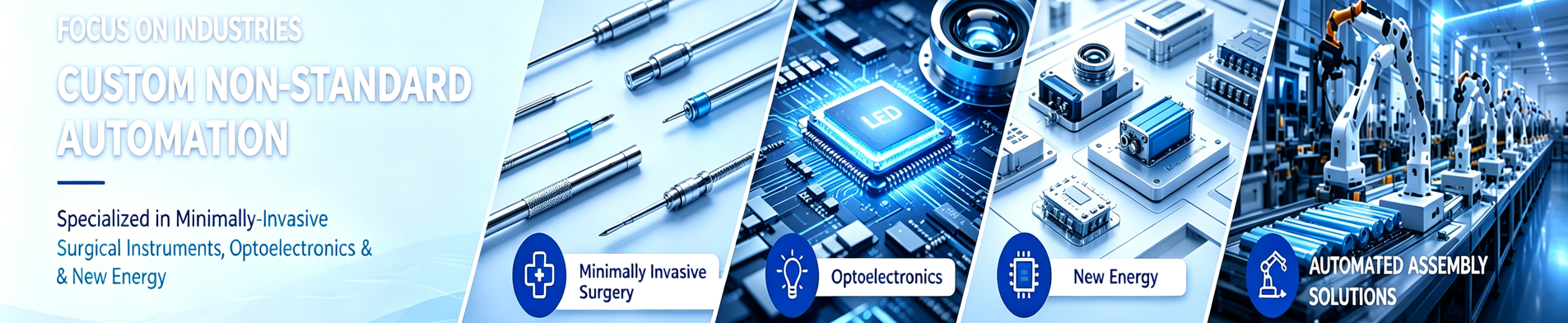

Specializing in the design of non-standard automated production lines. Proficient in OEE (Overall Equipment Effectiveness) optimization and phased automation implementation, ensuring the high-precision assembly of medical and lighting products without interrupting production.
| Factor | Fixed Automatic Assembly Line | Modular Automatic Assembly Line |
|---|---|---|
| Best For | High-volume, single-product, long lifecycle | Multi-product, mixed-batch, short lifecycle |
| Flexibility | Low (single-use only) | High (reconfigurable, scalable) |
| Throughput | Highest possible | Slightly lower than fixed lines |
| Upfront Cost | High (custom tooling) | High per module, but lower long-term cost |
| Changeover Time | Weeks/months (full retooling) | Hours/days (module swap/reprogram) |
| Maintenance | Simple, stable | More complex, but easier fault isolation |
FAQ
1. Can a fixed assembly line be converted into a modular one?
Partial retrofitting is technically feasible, but rarely cost-effective. Fixed lines rely on custom hard tooling and integrated structures, so converting them usually costs nearly as much as building a new modular line. It is more practical to deploy a modular line directly for flexible production needs.
2. Are modular lines less reliable than fixed lines?
No. Modern modular lines use standardized industrial components and unified control systems, delivering stability close to fixed lines. The only minor difference is slightly lower maximum throughput, while modular lines offer better fault isolation and faster recovery to reduce overall downtime.
3. Which industries are best suited for modular assembly lines?
Modular lines are highly recommended for industries with frequent product iterations, strict compliance requirements, or small-to-medium batch production:medical devices, in vitro diagnostic (IVD) reagents, LED lighting, consumer electronics, automotive electronics, and smart home appliances.
4. Do modular lines require more skilled operators?
Modular lines need technicians proficient in PLC programming, module debugging, and program switching for changeovers. Fixed lines require less specialized daily operation, but demand highly skilled engineers for major retooling. Many automation suppliers (like Synrit) also provide on-site training and remote support to lower the technical threshold.



 IPv6 Network Supported
leave a message
Scan to Wechat/Whatsapp :